Thursday, 6 June 2013

A manifesto for philosophers marking social science PhDs?

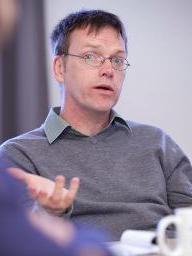
I had the privilege to act as the internal examiner for my colleague Karen Wright today. Following a unanimous recommendation in the pre-viva reports, the two externals (Michael Coffey (pictured) and Theo Stickley) and I also agreed a recommendation of a PhD award with minor corrections. (Of course, this is just a recommendation to the degree awarding powers of the University, as we emphasised with due correctness.)

Now it is a feature of PhDs at my university that the director of studies is often present as a silent witness to proceedings and after today’s happy occasion the DoS, my rather excellent colleague Gill Thomson, commented, in the nicest possible and uncritical way, that she thought that I had given her student something of a grilling. This might be, she conceded, in part a feature of her own perception and position: hearing but unable to respond to questions. But I suspect that it is more likely the action at a distance of the philosophical habit of thinking that the nicest way to greet a colleague's birthday festschrift collection is to give them a good kicking and then publish the result. But it prompts me to ask, what should a philosopher do in a social science PhD viva. What should be our manifesto?

It may be easier to approach this from the contingency of PhD work in my School. We like to ground empirical work exploring the experiences of patients or health-workers in a methodological framework which owes something to some dead German philosophers. I 'll assume that this is standard. (My external colleagues today suggested that it wasn’t, in fact, but I will ignore that detail for the moment.) If so, what should we, fairly applied philosophers, do in vivas?

Here’s my suggestion though first I want to reserve the right to do anything appropriate. Like the academic contract which finishes with the comment: ‘and any other reasonable request of the head of department’ no manifesto should be restrictive of what is best in local particular circumstances. Phronesis rules. But the paradigm role might be something like this:

To take the descriptions of the framework within which empirical findings are presented and explore what is meant by the student by them.

Part of this approach is that one should not attempt to ‘combat’ an invocation of Heideggerian phenomenology, for example, by bringing to bare what Wittgenstein might say, had no mention been made of him. (Here is a contrast with my role in a philosophy PhD viva.) So the idea is to take only things which are there in the text and invite a clarification of what they mean to the author in the light of other things written. The manifesto idea is that there is no need to do anything more than that. Further, one can learn something from the resolute reading of Wittgenstein in this sense: the role is not to police the limits of sense by ruling out some things as obviously nonsense or foolish but to offer an immanent critique in a standing invitation to the candidate to explain what might be meant by them by even non standard combinations of words.

In fact, I think that this is pretty much what I do as a philosopher in residence in a school of health. Surely, therefore, there is no ‘grilling’ involved? Just reflecting on what students have written in their own words, reflecting it back to them and inviting them to make sense of what they themselves have said. Pussy cat stuff, really.

Tuesday, 4 June 2013

Nature and artifice at Center Parcs

Against my expectations – my wildest expectations, perhaps – of a couple of days before, I spent the weekend at Center Parcs (a half term weekend, what’s more). There was a reason: good company and my partner’s god-motherly duties coupled with unexpected contingencies. But it gave me a second opportunity (after about ten years) to experience a peculiarly domesticated version of nature and to reflect on how it isn’t so very unusual in the UK with its couple of millennia of close living and domestication of the the natural environment.

For those who don’t know, Center Parks is a kind of middle class re-invention of a working class holiday camp. Butlins and Pontins were situated at seaside resorts. Cabins, access to the beach, and red coated entertainment officers made for a dense package which flowed and then ebbed in the 1970s with the growth of cheap package holidays to countries with more reliable sun. Center parks arrived from Europe in the 1980s as a less vulgar and more subdued version in which the entertainment focus had been diluted with a bit of Thoreau. Cabins were now cleverly hidden from one another. Entertainment was more subdued: redcoats now bird knowledgeable wardens. The specific climax of the beech transformed into a more general atmosphere of woodland.

So a weekend at one of the handful of Center Parcs in the UK is a weekend in a cabin in the woods. There is a surprising volume of birdsong. Deer wander through the trees. Rabbits and birds are oddly close to hand. It is an encounter with nature for people living in the great urban density of the UK. 

I should say that there is range of other things to do aside from bump into nature, under some understanding of it. With enough money, one might spend most of the day playing sport, practicing archery, playing on quad bikes etc. The key – free once there – element of all the venues is a substantial swimming pool with water slides, rapids wave machines etc. But despite all this, the architectural packaging of the site is as an encounter with nature. Everyone rides bicycles around a car free zone on paths through woods.

And that prompts the question: what kind of conception of nature is available? I want to add two comparisons.

1: Yosemite. Weirdly, Center Parks is a bit like Yosemite. Both have a dense area of accommodation. Both try to balance commercial facilities – bars etc – with a nature orientation. At both, people who might normally spurn public transport delight in free, centrally provided shuttles. But there is a big difference. Wander outside the accommodation area at Yosemite and you stumble into Ansel Adams territory. Nature with a capital N. Break through the boundary fence at Center Parks and you arrive in the middle of the surrounding agricultural farmland. So the play with nature is somehow more artificial.

2: The Lake District. The English Lake District is in no sense a wilderness. (No part of the UK really is,  with the possible exception of Knoydart in Scotland.) It is not the result of nature alone. The landscape, pretty though it is, is the result of a mix of farming, quarrying and small scale industry (eg explosives). Still, it does not derive from a conception of what countryside should look like but from an evolution of the landscape. So it isn’t so directly artificial.

Having run round the perimeter of Center parks, I returned home to do a similar length run on Scout Scar in the evening (about 7km). In the former case, the run stretched my suspension of disbelief, partly because it made me bump up against the perimeter fence (no doubt the focus of attention in a dystopian novel) and thus emphasised the artificial. On the Scar, the natural boundary of the cliffs give a view of 20 miles into the Lake District. Although without human intervention it would, no doubt, be wooded (like all the now bare Cumbrian fells) and is thus an artificial environment, its vegetation kept in check by sheep and a herd of Galloway, it is unbounded, the location fixed by geology rather than commercial planning. And this seems to be what makes Center Parks seem to be playing - albeit very successfully - at being in nature. Wander in any direction and one can look out at what seems more real, prior, beyond it and thus realise that it is merely plonked into the surrounding countryside in four places in the UK and 22 in the rest of Europe.

Saturday, 1 June 2013

Garrath Williams on the claims that actions make

I will try to summarise Garrath Williams’ stimulating presentation at the UCLan philosophy research seminar this week and then frame my lingering doubts as to whether I really understood the main idea. (The bitty style is the result of taking notes, not the presentation.)

The main claim seemed to be that actions enact normative claims and thus, through actions, normativity is introduced into the world. That slogan was meant to diverge from a conventional view in which actions are distinguished from mere movements by a machinery of mental states (eg the beliefs and desires which cause it, on the familiar Davidsonian view). On Williams’ view, the action itself and the claim it makes are closer. It was also supposed to fit better a view of the moral significance of action (and that seems to be the species of normativity in the idea that an action enacts a normative claim). If someone has moral authority, then she exercises this in all she does and says.

The presentation had three sections.
One, on the Kantian heritage of the claim and some potential objections to it.
Two, two motivations and two arguments for thesis.
Three how objections can be accommodated. I will try to summarise these in turn.

Section 1: The Kantian background. 

Viewing actions as normative claims is a Kantian idea. It recalls the idea that connects what is good with enacting a maxim. On Williams’ view, each action advocates a piece of advice but this idea can be separated from the more inflationary metaphysical baggage of the traditional Kantian picture. Being a responsible person involves making normative claims and counter claims. Being a responsible person is a non-natural fact: a matter of mutual recognition. (I wasn’t sure whether this made it a purely attributive notion or whether the attribution was correct in virtue of something independent of it. There is a similar issue, though not about norms, in Dennett and Davidson. But he did say that he wished to play up inter subjective factors and be less psychologistic than conventional accounts.)

Four objections:
1: we don’t have a maxim in mind, so the account is psychologically implausible.
2: many actions dont seem to follow maxims or make claims. So it is normatively extravagant.
3: effects may go missing by contrast with maxims, ie not material enough.
4: even when action does raise issues, it is often hard to work out what the claim is. Diverse possibility of interpretation of action.

Section 2: Two motivations and two arguments.

The two motivations ran as follows:
1: if actions make or enact a norm claim then there is a quick link to why they call out for moral assessment. Cf the connection between beliefs and truth.
2: if an action counts as a false claim then it calls for rebuttal. Hence we have a reason to ask whether it contributes to the framework of norms we share and to people responsible in order to rebut wrong claims. 

The two arguments ran:
1: What matters is not the psychology of the doer but the relation to audience. Normally an action enacts a normative claim because it is the way others learn where we stand as agents.

2: Consider the example of walking down the pavement without looking where one is going. This suggests that one thinks that others have a duty to get out of the way. Even the solitary act of buttering toast in one’s kitchen is a claim that one is allowed to use one’s possessons and hence that others have a duty not to interfere. Even innocent actions implicate others. (But, Williams conceded, it would go beyond the data to say that the agent is committed to property rights. ) Psychologically, agents may not want to make claims about others. But no responsible person is entitled to make that refusal. They have no choice but to create a normative framework. So each agent is duty bound to contribute to upholding norms. So if their actions rely on various conditions, then they may be understood as claiming that.

Section 3: The four objections again.

1: the account isnt meant to be psychological. We take for granted that people reveal their commitments. That actions set precedents.

2: what of trivial actions? Not as trivial as they seem. There’s a wider normative context. But the normative claims of trivial actions is not relevant to others. It is not other people’s business to ask what the actions mean.

3: take the example of common assault. The agent of an assault has made an extraordinary claim about the victim. Intuitively, the agent has to retract the claim by acknowledging effects. So effects do not go missing on the account.

4: problems of interpretation. But that is true of any account. It is a basic fact of social life. The meaning of action is often hard to make out. Normative claims of private actions whatever norm they do express are not challenging others.

In a final comment, I think I heard Williams to say that the central claim is also a kind of normative injunction: not just that actions do enact claims but we should treat actions as enacting norms.

All this left me with the following worry. If I heard the claim correctly, the thesis was about the meaning or content of actions, their intentionality. In other words, whilst Williams rejected the mechanics of inner states that is often taken to explain the content or the intentionality of actions, he was in the same general area of the ‘phenomenology’ of distinguishing or articulating just what an action is (for example, a flicking of a switch and also - because in order to achieve - a turning on of a light but not, qua intentional action, an alerting of an unknown prowler; the agent will not say that that is what she was doing). But if so, first, why take the claim to be making a normative claim as opposed to a descriptive one? Here are two ways to make that vivid, though I suspect Williams will not be happy with either set up.

On the Davidsonian picture, the intention of an action derives from two aspects: a belief and a normative pro-attitude. Now even if we think that there need not be two inner mental elements corresponding to this, the face validity of the picture is that, often at least, two such dimensions can be articulated in the reasons for an action. So why insist that the claim which an action makes is just the normative side?

I can imagine that Williams might respond to this thought like this. Even on this standard Davidsonian picture, there is an all out judgement that such and such an act is desirable enough to be done, or, just, is to be done. That stems from the beliefs and desires of the agent but is itself a judgement with normative force. Hence the normativity of the claims that actions make. However, Williams stressed the generality of the claims that actions make in saying that they give advice and in connecting them to a Kantian background. By contrast, the all out judgement is particular (tied to this action), not general, so it cannot be the normative claim Williams was talking about. And if, instead, the claim an action makes is one of the potentially general elements that motivate that particular normative judgement, my question remains: why pick the normative rather than the descriptive element?

Second, take the example of a species of action: an act aimed at communicating something such as the whereabouts if a hidden cat either by pointing at the bookshelves or by saying “the cat is on the shelves”. What claim does such an action make? What is the content of the action? Williams would point out that to make the claim is to take oneself to be justified so to do and a host of other connections (that others should attend, that their prior questioning commits them to listening to the answer etc). But surely the obvious candidate for the claim made is none of those but rather that that is where the cat is?

The further advantage of this more traditional view is that it helps sidestep the question of just which of the eternally ramifying network of norms that make a claim possible should a particular act be thought of as making. That entire network may be necessary for the content of a particular act, but why think that the act claims it to be so?
Friday, 17 May 2013

Wellbeing: conceptual or preconceptual?

There was an interesting moment in a supervision with Laura Buckley today, this time prompted by something my colleague Bernie Carter (pictured) said. Thinking about how effective the older people whom Laura had interviewed were in thinking through and communicating their thoughts about their wellbeing, Bernie, who is interested in children's pain on the nicest interpretation of that phrase, commented on the broad opposing views of pain and language. On one, language fails to communicate the real nature of pain, which is private to the sufferer. On the other, there is an essential connection between pain, expressing pain, and communication and hence no gap between what is felt and what communicated. (As an ex Wittgensteinian, my hand is tied in this debate, of course.)

Now in the somewhat boisterous cut and thrust of supervision without the steadying hand of Laura's director of studies, I missed the exact nature of the connection Bernie was suggesting. But it prompted the following thought. Unlike the pain case, where maintaining the second view takes a bit of philosophical work against the insidious idea that pain is pain whether or not it is there to be expressed (and hence it would be merely good fortune if it could be put into words), my intuitive thought about wellbeing goes the other way.

Roughly, it is a pre-philosophical view that to enjoy wellbeing is already to be in the space of reasons. A state of wellbeing is not one which one can enjoy without some conception of a life to be lived and a realisation that one is living it, even if merely in part.

(Perhaps one needn't have a conception of a life as a whole but merely of an aspect. For example, that one likes the conviviality of the pub with friends on a Sunday lunchtime. But my hunch, an argument for which I rather owe, is that that only works in the context of at least an inchoate conception of a life into which that aspect fits. The context in which the beer is pulled by slaves and the pub heated by burning kittens is not one which will enable such a visit to sustain wellbeing. One will need to take it - truely or falsely - to be the case that that is not how things are. Hence an escalation of conceptions from the specific to the general.)

But although I want to suggest that it is pre-philosophical, the hunch comes under threat from the fact that 'wellbeing' simply isn't a word in vernacular use. Laura has had to fish for an appropriate understanding of it whilst not pressing specific interpretations (and thus undermining the objectivity of her research). So how could it be that one must be self-conscious to enjoy wellbeing if neither the word, nor a convenient synonym (had there been one, Laura would have used it) is in popular use?

I think that the answer to that is that there are a number of distinct ways for agents or actors to pick out aspects of living which the interpretator or theorist take to be wellbeing. So the conception under which the life is so conceived is a mere aspect for which the theorist can provide a rationale for taking it to be an aspect of wellbeing.

This suggests something like the following interesting possibility. There may be a different kind of gap to the one Bernie was sketching. Not between a preconceptualised state (wellbeing as akin to pain on a non-Wittgensteinian view) and its linguistic expression but between the theorist's conception of wellbeing at an abstract level and the agents' conceptions of different ways in which it can be realised. Perhaps agents' conceptions of what the theorist takes to be wellbeing have nothing independent of the theorist in common?

Wednesday, 15 May 2013

Tacit Knowledge book out now

My co-authored book, with Neil Gascoigne, Tacit Knowledge, Durham: Acumen, is out now in hard and soft covers.

Later, I must try to frame some thoughts about the co-authoring process which really is quite a strange one in philosophy, a subject in which no two people would be expected to think alike.

Health Research with Real Impact conference

I've been at the Health Research with Real Impact conference today. With a wide ranging programme across the field of health research, I wasn't sure how much, as a mere philosopher, I would be able to understand. But the unifying theme of the morning, although called 'knowledge management', was more specific even than that. Roughly, why is it that potential innovations backed by good quality evidence are not easily adopted? Why are 45% of well researched innovations not taken up?

Here are two specific examples, both from cancer care. My colleague Kinta Beaver discussed resistance to the idea of using telephone follow-up consultations in place of hospital based face to face encounters despite both its popularity  with patients and with its clinical effectiveness. Thomas Hack, from the University of Manitoba, discussed the problem of first consultations for those diagnosed with cancer.  Typically, he reported, patients are anxious and as a result fail to take in or retain information put to them. The answer, which is hardly rocket science, is to record the consultation and give the patient a copy at the end. But the interesting thing was that despite good quality Cochrane review evidence for its effectiveness in a variety of degrees there was little initial uptake for it

Different speakers gave different examples of specific approaches to addressing the gap between good evidence and change of healthcare practices. For example, Janice Eng of British Columbia showed a website which ranked research papers relevant to spinal cord injury but also made available unpublished research (which interestingly increased subsequent journal publication rather than diminishing it).£But I was more interested in the reason for the inertia in the first place. Tom Hack reported that whilst all the clinicians he interviewed about recording consultations shared a view of its probable efficacy (there being much published evidence) they disagreed about the specifics of the perceived obstacles. It seems oddly coincidental that all agreed that there would be obstacles but they disagreed about the particular reasons. What, I want to ask, is the real reason? Is it simply a universal conservatism? Is there anything more interesting behind this?

I was also struck by an ironic reversal. At the start of the morning, a couple of speakers invoked the idea of 'mind-lines' to explain entrenched habits  of thought which might explain inertia in the face of change. This is not an idea I have heard expressed before in UCLan. But in questions later, this conceptual innovation was eagerly embraced by nearly everyone. No inertia there.£

Friday, 10 May 2013

LSE panel discussion on mental illness

I took part in a panel discussion at the LSE this week under their Consilience series. Matthew Broome and Bonnie Evans were the other panel members, it was chaired by Kristina Musholt, and organised by Juliana Cardinale. In a packed - and very swish - lecture theatre, I found the questions from the audience varied and helpful and, despite the contested nature of mental healthcare, surprisingly good natured. But I regretted afterwards that we failed to provide a really clear outline of the logical geography of the philosophy of mental illness: mainly my fault, I could have done so but chose instead to give an overview of activity in philosophy and psychiatry. (There is a podcast of the event available here.) But one other coincidental aspect of the evening struck me.

Between 1991-3, I worked at the LSE as a university administrator before going round the world for a year. It was an emotionally charged period in that I had to learn a lot quickly about non-academic work in which I was hugely helped by a fine boss (Michael Arthur); there was a surprising degree of pressure elsewhere in the administration (much shouting on other floors); and I had simultaneously to rewrite my PhD from scratch with a new supervisor. Memories from those two years often come back to me. And hence, I assumed that if I were to walk into the building in which I used to work and where I would arrive with some trepidation every morning that memories would flood back, that I would have an affective response. Weirdly, I tried the experiment and nothing happened. I cannot project myself back into that life any more. All the facts are the same - I remember just as much - but the affective colouring has gone. Odd to have no first person authority in advance over this.